There are some wildlife encounters that feel inseparable from Africa itself. Not just rare or renowned, but rooted in the very landscape and rhythms of the continent. On World Earth Day (April 22nd), we're reminded that protecting our planet is not only about saving individual species but also the places that make their encounters possible. And few places bring that to life quite like here in Madikwe.
Madikwe is one of the very few reserves where guests may encounter what we like to call the Super 7 plus 1: lion, leopard, elephant, buffalo, white rhino, black rhino, wild dog, and cheetah. That combination alone makes for extraordinary encounters. Add to it the possibility of seeing creatures as elusive as an aardvark or pangolin, and the sense of wonder only deepens...
The African wild dog is one species that captures Madikwe's wildlife conservation significance especially well. Fewer than 6,600 remain in the wild today, making them one of Africa’s most endangered carnivores. They are also among its most successful hunters with a hunting success rate cited far above that of lions. Yet, what tends to leave the greatest impression is not their hunting skills but their pack dynamics: the constant communication and support for one another, from exuberant morning greetings to the way food is regurgitated for pack members that missed the kill. To encounter wild dogs here is to experience something thrilling but also something precious and hard-won.
Then there is the aardvark, a species completely unique to Africa. Also known as the "African ant bear" or "anteater", the aardvark is the sole living member of the order Tubulidentata, a nocturnal burrower with an important ecological role as their burrows often go on to provide shelter for many other animals once abandoned. They are widespread across sub-Saharan Africa but famously difficult to see, which makes every sighting feel almost miraculous.
The same can be said of Temminck’s ground pangolin. Although pangolins also occur in Asia, the Temminck’s ground pangolin is a uniquely African species. It's also one of the most trafficked mammals in the world, and yet in Madikwe there remains the rare possibility of seeing one on a night drive. If that happens, you are witnessing one of the continent’s most secretive and vulnerable creatures ~ a privilege very few travellers ever experience.
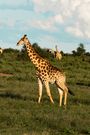
Not every encounter has to be rare in order to feel iconic though. The giraffe, for instance, can be seen in zoos around the world yet its natural home lies exclusively on the African continent. To watch one move across the bushveld ~ slowly, deliberately and oh so elegantly, is to understand its place in the world in a way no enclosure could replicate.
And then, also striding across the plains with measured precision is the secretary bird: an African species unlike any other bird of prey. Rather than hunting from the sky, it stalks its prey on foot, delivering strong, deliberate strikes that subdue snakes and other small mammals.
From the elegant spiral horns of the greater kudu to the vivid colours of the lilac-breasted roller, Africa’s wildlife is defined not only by its beauty and diversity but also its distinctiveness. These are not just animals you see; they are animals that truly belong. And what makes Madikwe so special is not simply the checklist but the context: a protected area where these species can still move, hunt, mate, nest and endure.
Earth Day calls us to think about the future of our planet and safaris remind us what that future must still make room for: wild dogs at dawn, rollers flying past in the light and, somewhere out there, a pangolin moving silently through the African night.









Comments
Be the first to write a comment.